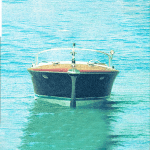
Year of construction: 1962 | Number built: 769 | Length: 8.02 metres | Versions: Special, Lungo and Super
After extensive testing of the first Aquarama, Carlo Riva’s personal boat LiPiCar, production began in 1963. The hull was identical to the previous model, the open Tritone. Distinctive features included the anchor hatch on the foredeck and the extended spray rail. The dashboard was completely redesigned and finished entirely in mahogany, fitted with new VDO instruments. The interior was updated with a separate driver’s seat and a two-person front bench, significantly improving access to the cabin. Not only the interior, but also the aft deck was extensively revised. The sunpad and recessed transom with a removable swim ladder provided easier boarding.
Super Aquarama
The Super Aquarama was initially equipped, from 1963 to 1966, with Chrysler M413D engines. These marinised ‘Big Block’ engines, featuring specially designed dual intake manifolds for Riva, produced 320 hp. From 1967 onwards, Riva introduced its own 320 hp engines, derived from GM Chevrolet Corvette blocks. Due to the many modifications and patents, Riva was able to market these under its own name. Apart from the longer hull, there were few differences between the standard and the Super Aquarama. Production of both versions ended in 1971. Not coincidentally, LiPiCar IV, hull number 486 and Carlo Riva’s final personal boat, was the last to be built.
Aquarama Lungo
The Aquarama Lungo, built in 1972, was an intermediate model of which only seven were produced. The name ‘Lungo’ refers to its increased length of 8.72 metres, intended to accommodate 350 hp engines. However, these engines were never installed in the Lungo and were only used in the final version of the Aquarama, the ‘Special’. The Lungo was fitted with the standard Riva 220 hp engines.
Aquarama Special
he Aquarama Special, with its extended transom and sharper bow line, was a modification of Carlo Riva’s original design. It was introduced at the request of a client who found the accessibility at the stern insufficient. This change proved highly successful, and between 1972 and the final production year in 1996, a further 278 units were built. During the final production period, many components were adopted from the new generation of fibreglass Rivas. Most notable were the redesigned dashboard with smaller VDO instruments and the Momo sports steering wheel. The end of the Aquarama Special also marked the end of an era that defined Riva: that of the ultimate classic mahogany speedboat.