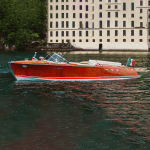
Production years: 1953–1974 | Number built: 1004 | Length: 6.58 metres
The Ariston, like all Rivas of the 1950s, was developed from a preceding model. Originating from the prototype BF and its successor the BM in 1950, the Ariston was introduced in 1953. In that year, from hull number 18 onwards, series production truly began. The name Ariston means “the very best”, reflecting Carlo Riva’s ambition with this model. Many construction ideas were derived from the Florida, which served as a test platform for various developments at Riva.
In 1957, all hull components were made from waterproof plywood, marking the end of the planked hull era. The distinctive panoramic windscreen was introduced, along with a matching convertible top. Until 1964, numerous modifications were implemented, including improved instruments, different interior materials and the introduction of a stainless steel fuel tank.
From 1960 onwards, the Ariston was also available in a Super version. These models featured more powerful engines than the standard Ariston, although they were not the first to be equipped with higher output engines. Between 1956 and 1958, Riva delivered 19 units fitted with 250 hp Cadillac engines. Due to their rarity, this series is perhaps the most sought-after version.
During the 21 years that the Ariston was in production, the length increased from 6.25 m to 6.95 m. As the length increased, the hull shape became sharper. In 1967, both the standard and Super versions were given the same length and fitted with a deep-V hull. In 1971, Riva ceased production of the standard Ariston, after which only the Super version remained available until 1974.