
Production years: 1952–1964 | Number built: 1137
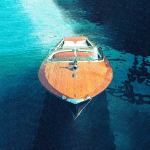
The Florida was introduced in 1952, the same year as the Sebino, but offered more options. The standard Florida was approximately 50 cm longer, while the Super version was nearly a metre longer. The additional space provided a sense of comfort and luxury that the Sebino lacked. Until 1963, the dashboard featured Stewart-Warner and Chris-Craft instruments. From that year onwards, with the introduction of gauges developed by VDO, all models were equipped with dedicated Riva instruments. Throughout the entire production period, various modifications were made, the most significant being the pressed wooden hull panels. Riva was the first in the world to use moulded hull panels made from waterproof plywood, built up from three layers. This allowed Riva to achieve faster production times and higher quality.
In 1964, production of the standard Florida ceased after 426 units, and Riva continued with the Super version, of which a total of 711 units were built until 1967. The success of the Florida can be attributed to many factors. It is a boat suitable for both sporty and recreational use. The model has an almost minimalist classic elegance, which makes it highly desirable even today.
Super Florida.
The designation Super indicates a more powerful engine type. Until 1960, the dashboard displayed only the name Riva Chris-Craft. In that year, the Florida was also offered with a Chrysler Sea V M80 engine. The unique partnership with Chris-Craft ended and was replaced by the Super designation. An additional advantage was that the gear lever could be moved from the floor to the dashboard. Apart from the increased length, the Super Florida featured more frames at shorter intervals, necessary to accommodate the more powerful engines. As with all Riva models, the hull shape became progressively sharper during production. The later Super Florida models are particularly sought after, largely due to the many improvements. An interesting detail is that the last 17 Super Florida boats built were transitional models and featured the sharper, flared bow of its successor, the Riva Olympic. In 1969, Riva ended production of the Florida after a total of 711 units.
Versions:
Year | Length × width | Engine | Number | Number built |
1952 | 5.40 m x 1.94 m 5.40 m x 1.94 m | BPM 115 Pk C.C. K 90 Pk | 2 3-6,8,9 | 2 6 |
1953 | 5.40 m x 1.94 m 5.40 m x 1.94 m | C.C. K 95 Pk C.C. KCL 120 Pk | 11,12,1416,18,24,25 10,13,15, 19-23,26 | 8 9 |
1954 | 5.40 m x 1.94 m 5.40 m x 1.94 m | C.C. K 90 Pk C.C. KCL 120 Pk | 31,32,34,35,36 28-30,3,36-55,57 | 5 25 |
1955 | 5.40 m x 1.90 m 5.40 m x 1.90 m | C.C. K 90Pk C.C. KCL 120 Pk | 59-63,79,92-94 64-78, 80-91 | 9 27 |
1956 | 5.40 m x 1.90 m 5.40 m x 1.90 m | C.C. K 90 Pk C.C. KCL 120 Pk | 120-129,137-157 193-197 | 31 5 |
1957 | 5.43 m x 1.91 m 5.43 m x 1.90 m 5.43 m x 1.90 m | C.C. K 90 Pk C.C. KCL 120 Pk C.C. KFL 131 Pk | 193-197 158-192,200 198,199,201,202 | 5 36 4 |
1958 | 5.40 m x 1.91 m | C.C. KFL | 288-322 | 35 |
1959 | 5.40 m x 1.91 m | C.C. KFL | 323-357 | 35 |
1960 | 5.40 m x 1.91 m | C.C. KFL | 467-502 | 36 |
1961 | 5.40 m x 1.91 m 5.40 m x 1.91 m | C.C. KFL C.C. 283 | 503,504 505-543 | 2 39 |
1962 | 5.40 m x 1.91 m | C.C. 283 | 544-593 | 50 |
1963 | 5.40 m x 1.91 m | C.C. 283 | 594-643 | 50 |
1964 | 5.40 m x 1.91 m | C.C. 283 | 644-647 | 4 |