Production years: 1969–1979 | Number built: 264
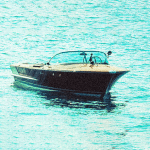
In 1969, following the 1968 Olympic Games, Riva introduced the Olympic. As the successor to the Florida, which was due for replacement, the smaller Junior with its negative transom and open layout served as the model. Carlo Riva wanted to give his final creation a modern appearance and was inspired by the rise of a new generation of fibreglass boats.
The relatively flat hull, rising sharply towards the bow and ending in a flared stem, provided forgiving handling characteristics. As an open sports boat, the Olympic was suitable for many purposes. The design was ideal for water skiing, as a tender or for a day of fishing. The low entry via the aft deck, spacious layout and numerous storage compartments made it a comfortable and user-friendly boat. If there was any criticism, it concerned the convertible top. The fabric canopy offered only minimal protection for passengers on the front bench. It operated on a sliding system and was stored beneath the dashboard, slightly reducing legroom.
The first production series was equipped with a 220 hp Riva Crusader engine. From 1973 onwards, Riva introduced a more powerful 270 hp version, partly achieved through the use of a larger carburettor.
A total of 264 boats were built over a period of 10 years. The relatively low number was due to rising production costs, a declining supply of mahogany and increasing competition from boat builders producing faster and more affordable fibreglass boats. After the final 10 boats were fitted with a Thermo Electron 270 hp engine, Riva ended production in 1979.